Nothing But Slick and Crystal Clear Exterior Surfaces

Premium Ceramic Coating Services near Frankfort, IL

Long-Term Paint Protection, Minutes From Home

A permanent, glass-like shield that stands up to Will County winters and keeps your vehicle looking new for years.

Why Frankfort Drivers Need Real Paint Protection

Whether you're pulling out of a subdivision off 80th Avenue, running errands along LaGrange Road, or heading north to I-80 every morning, your paint is absorbing damage long before you can see it.


Road salt is the biggest offender. Will County crews treat these roads heavily from November through March, and that brine works its way into every seam, edge, and stone chip in your clear coat. It keeps working through every freeze-thaw cycle until spring. Then summer arrives and UV exposure takes over, baking the finish on vehicles that sit in driveways and open lots all day. Add construction dust from ongoing development along Route 30 and the Lincoln Highway corridor, plus tree sap and pollen from the older canopy around Historic Downtown Frankfort, and your paint never really gets a break.


Most drivers assume factory paint is tougher than it is. It isn't. The clear coat protecting your color is measured in thousandths of an inch, and manufacturers spec it for cost and production speed, not for a decade of Illinois seasons. Wax doesn't solve the problem either. It sits on the surface, breaks down in a matter of weeks, and tends to disappear right when conditions turn harsh.


Protecting a vehicle in this climate takes something that bonds to the paint instead of resting on it.
CONTACT US
White Audi with gold rims parked in front of Olson's Detailing shop, featuring their logo.

What Exactly Is Ceramic Coating?

Ceramic coating is a liquid polymer built primarily from Silicon Dioxide (SiO2), the same base compound found in glass and quartz. Applied correctly to a properly prepared clear coat, it doesn't layer on top the way wax or a spray sealant does. It forms a chemical bond with the paint itself and cures into a hard, semi-permanent surface.


The easiest way to picture it is as a sacrificial barrier. Salt, UV rays, bird droppings, and industrial fallout hit the coating instead of your factory finish. Because the bond is chemical rather than mechanical, it doesn't wash away at the touchless bay or wear thin after a month of driving. Maintained properly, it protects your vehicle for years.

What Ceramic Coating Actually Does for Your Vehicle


  • Water and Grime Slide Right Off

    On a coated surface, water beads tight and sheets away instead of clinging. Slush from Wolf Road, spring mud along the Hickory Creek corridor, salt film from I-80, none of it grabs onto the surface the way it does on bare paint. Washing takes a fraction of the time, and you can get the vehicle clean without reaching for aggressive chemicals.


  • UV and Oxidation Defense

    Sun damage is gradual and permanent. Prolonged exposure oxidizes factory paint, leaving behind that dull, chalky haze that ages a vehicle years ahead of its odometer. Ceramic coating functions like sunscreen for your finish, absorbing UV before it can break down the clear coat. Your color stays deep and glossy, which protects both your daily satisfaction and your trade-in value.


  • Resistance to Chemical Etching

    Bird droppings are acidic. Tree sap is corrosive. Road salt is engineered to dissolve ice, and it treats your clear coat the same way. A ceramic coating creates a chemically resistant surface that stops these contaminants from burning into the paint. When something lands on your hood, you wipe it off and move on instead of finding a permanent mark underneath.


  • Deep, Reflective Gloss That Stays

    Coated vehicles stand out, and it isn't subtle. The coating increases clarity and reflectivity, producing a wet, glass-like finish that looks freshly detailed on an ordinary Tuesday. Metallics pop. Reflections sharpen. That just-detailed appearance holds for years instead of days.


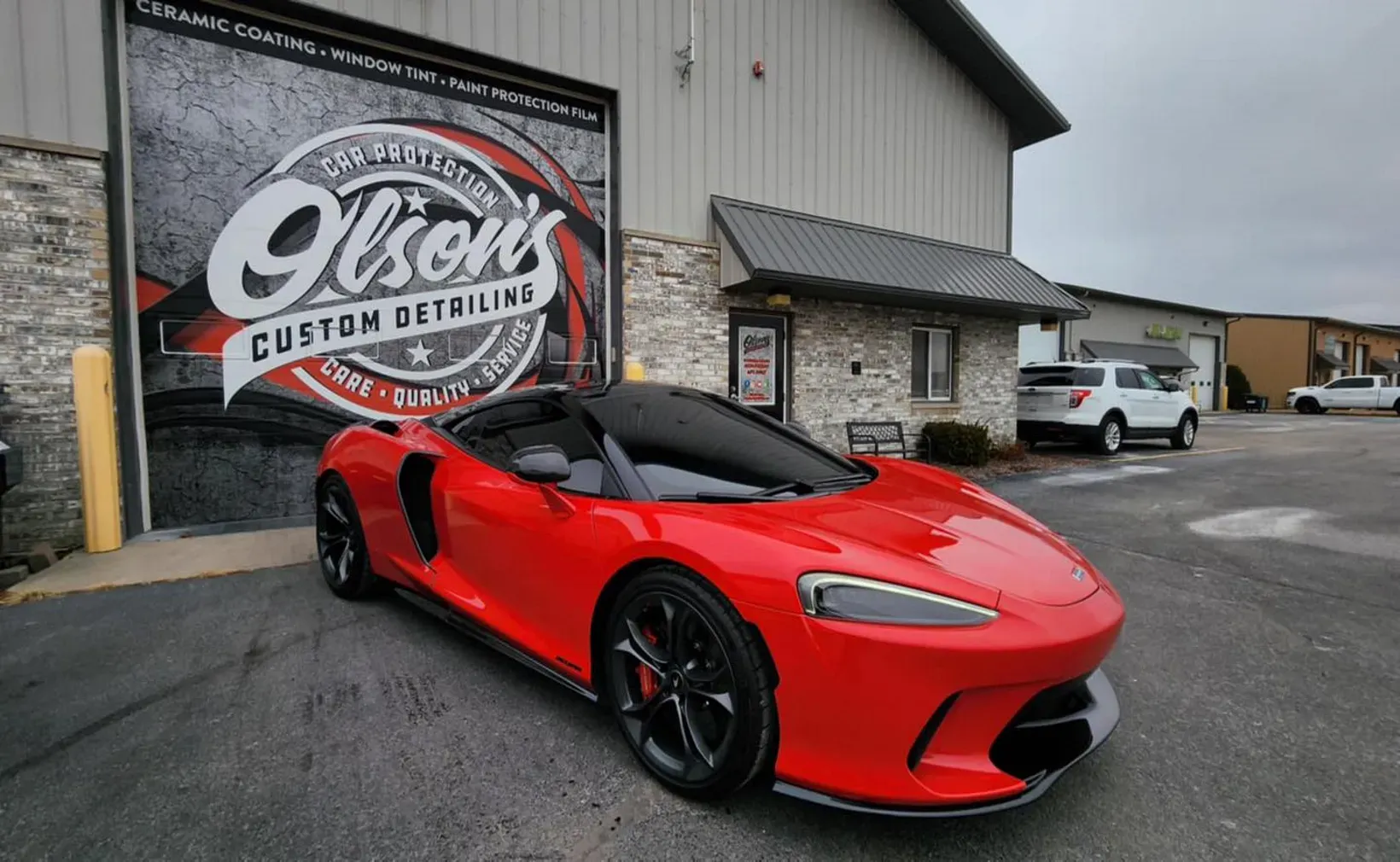
Red McLaren sports car in front of a detailing shop with a white SUV in the background.
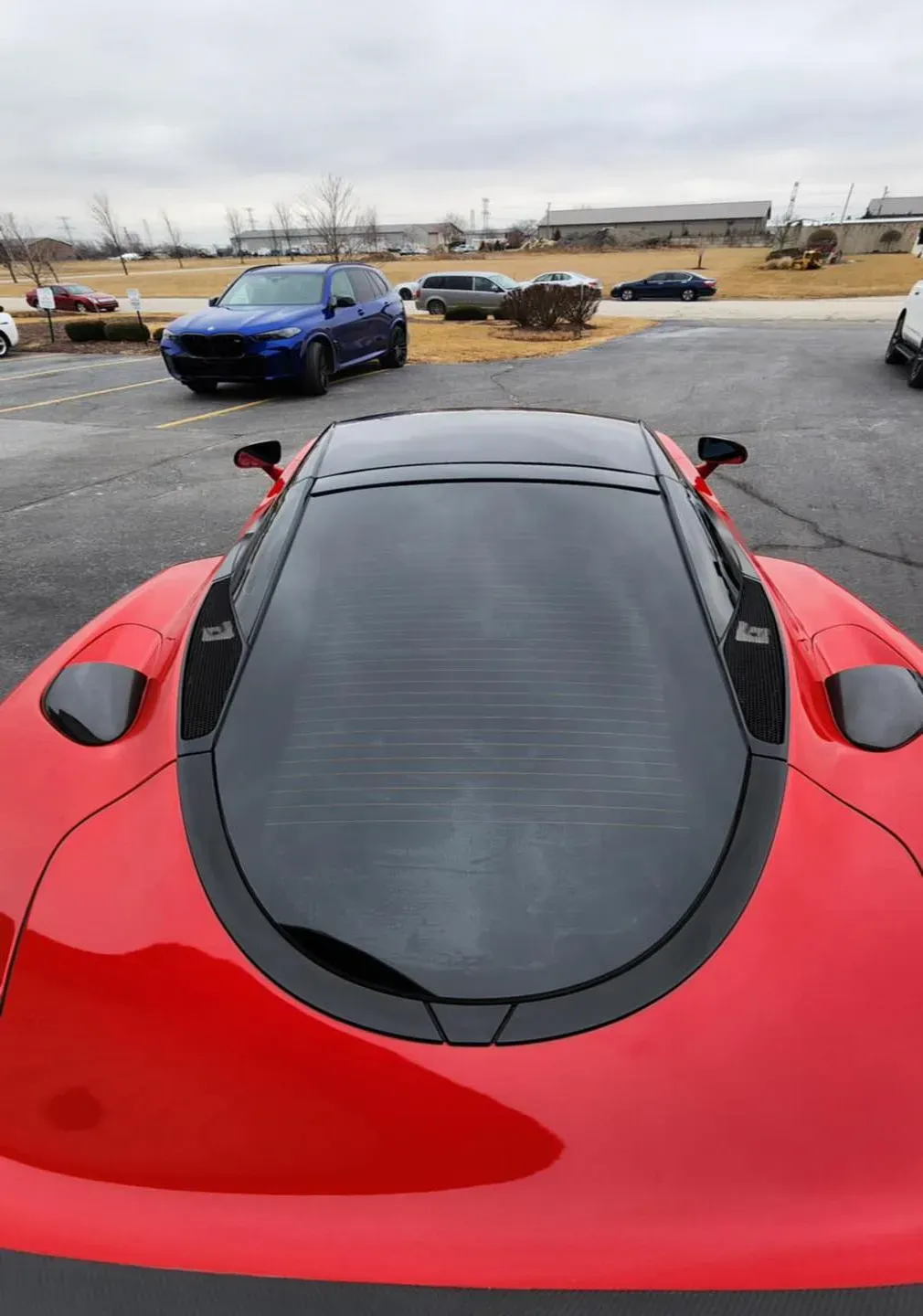
Red sports car with black roof, parked in a lot, other vehicles and buildings in the background.

Our Application Process and Why Every Step Counts

Ceramic coating is not a weekend driveway project. Done right, it's a controlled, multi-stage process that depends on preparation far more than on the coating itself. Here's how every vehicle moves through our shop:


Step 1: Full Decontamination Wash

We strip away old wax, sealants, and every layer of surface buildup. This isn't a quick rinse. The coating can only bond to a genuinely clean surface, so this stage sets the ceiling for everything that follows.


Step 2: Iron Removal and Clay Bar Treatment

Paint has microscopic pores, and those pores hold metallic particles from brake dust, rail dust, and construction fallout that's common throughout this part of Will County. A chemical iron remover dissolves the embedded contamination, then a clay bar treatment lifts whatever the chemical left behind. The result is paint that's smooth at a level you can feel with the back of your hand.


Step 3: Paint Correction, the Step That Cannot Be Skipped

Here's what catches most people off guard: ceramic coating does not hide defects. It seals them in permanently, and under direct light it can actually make them more visible.


Swirl marks from automatic car washes, wash-induced scratches, oxidation from seasons of sun exposure- all of it gets locked beneath the coating if the paint isn't corrected first. We don't allow that to happen.


Working panel by panel with professional polishing machines and compounds, we remove defects in stages until the surface is genuinely clean. This is the longest phase of the entire job, often several hours, and it's the difference between a coating that looks good and one that looks flawless.


Step 4: IPA Wipe-Down

Every panel gets wiped with an Isopropyl Alcohol solution before the coating goes on. This strips out residual polishing oils and leaves a surgically clean surface. The strength of the chemical bond depends entirely on how well this is done.


Step 5: Controlled Application and Cure

Ceramic coating cures through a chemical reaction that reacts to temperature and humidity, so application happens indoors in a controlled bay. We work in small sections for even coverage and inspect each panel under high-intensity lighting to catch high spots or streaking before anything sets.


Once applied, your vehicle stays with us until the coating has hardened and reached full bonding strength. That timeline isn't negotiable. Your vehicle goes home when it's ready, not when it's convenient.

Why Frankfort Drivers Choose Us


We're Right Down the Road

Our shop sits in New Lenox, just minutes from Frankfort, so this isn't theoretical local knowledge. We drive LaGrange Road and Route 30. We know how salt exposure on I-80 compares to what accumulates on residential streets over a long winter. That context shapes how we prep every vehicle before a single drop of coating comes out.


Trained Installers, Professional-Grade Products

There's a real reason a $50 retail kit and a professional installation aren't the same purchase. Professional coatings carry higher SiO2 concentrations, cure significantly harder, and last far longer. Just as important, applying them correctly is a learned skill. We've put in the hours to apply these products without streaks, without high spots, and without the hazing that turns up weeks later on rushed work.


No Volume Shortcuts

Some shops maximize throughput by pushing vehicles out the door. That's not how we operate. Every vehicle gets the hours it needs. We don't skip correction, we don't coat contaminated paint, and we don't release a car mid-cure. Long-term protection matters more to us than a daily car count.


Ready to Protect Your Vehicle?

Every unprotected week is more UV exposure, more salt contact, and more opportunity for contaminants to etch permanently into your finish. The roads around Frankfort are hard on paint, and the damage compounds quietly.


Reach out today for a consultation. We'll evaluate your vehicle's current paint condition, discuss what level of protection makes sense for how you drive, and give you a detailed quote.

Frequently Asked Questions

  • How long will a ceramic coating last through Illinois winters?

    A professional application typically holds up for 2 to 5 years depending on the product tier and how the vehicle is maintained. Winters here are exactly the conditions ceramic coating was engineered for. It resists salt chemically, and its hydrophobic surface helps slush and brine release during washes instead of sitting on the paint. We recommend a maintenance wash roughly every two weeks through salt season to get full life out of the coating.


  • Do I still have to wash my car after it's coated?

    Yes, but it's noticeably easier. Ceramic coating isn't self-cleaning. What it does is prevent dirt, salt film, and grime from bonding to the surface, so contaminants release with far less effort. You'll still wash the vehicle, but it takes a fraction of the time and doesn't require harsh chemicals. The coating simplifies maintenance rather than eliminating it.


  • Will ceramic coating remove scratches or swirl marks?

    No. It's a protective layer, not a corrective one. It preserves your paint in whatever condition it's currently in, which is exactly why paint correction is a mandatory part of our process. Scratches, swirls, and oxidation get addressed during the polishing stage, and the coating then locks in that corrected finish.


  • Is ceramic coating actually worth it compared to wax?

    They're not really competing products. Wax gives you 4 to 6 weeks of light protection at best, washes off quickly, and demands constant reapplication. Ceramic coating bonds chemically and performs for years, with far stronger defense against UV, chemical etching, and environmental fallout, plus a level of gloss no wax can match. The upfront cost is higher, but measured against three to five years of monthly waxing in time and product, the coating is the better value.